



(The following is adapted from the chapter Public Miners Sentiment and Performance in the Bitcoin Mining Market Review (2025–2026 edition). The report was produced in collaboration with Digital Mining Solutions and is supported by NiceHash ❤ )
As people review their portfolio performance from the previous year and consider necessary adjustments for 2026, a familiar question resurfaces: should exposure be trimmed from Bitcoin mining equities in favor of holding more Bitcoin directly?
With the Bitcoin price trading well below it highs, this question feels especially relevant. But, first, let's review how Bitcoin and Bitcoin mining sector performed in 2025.
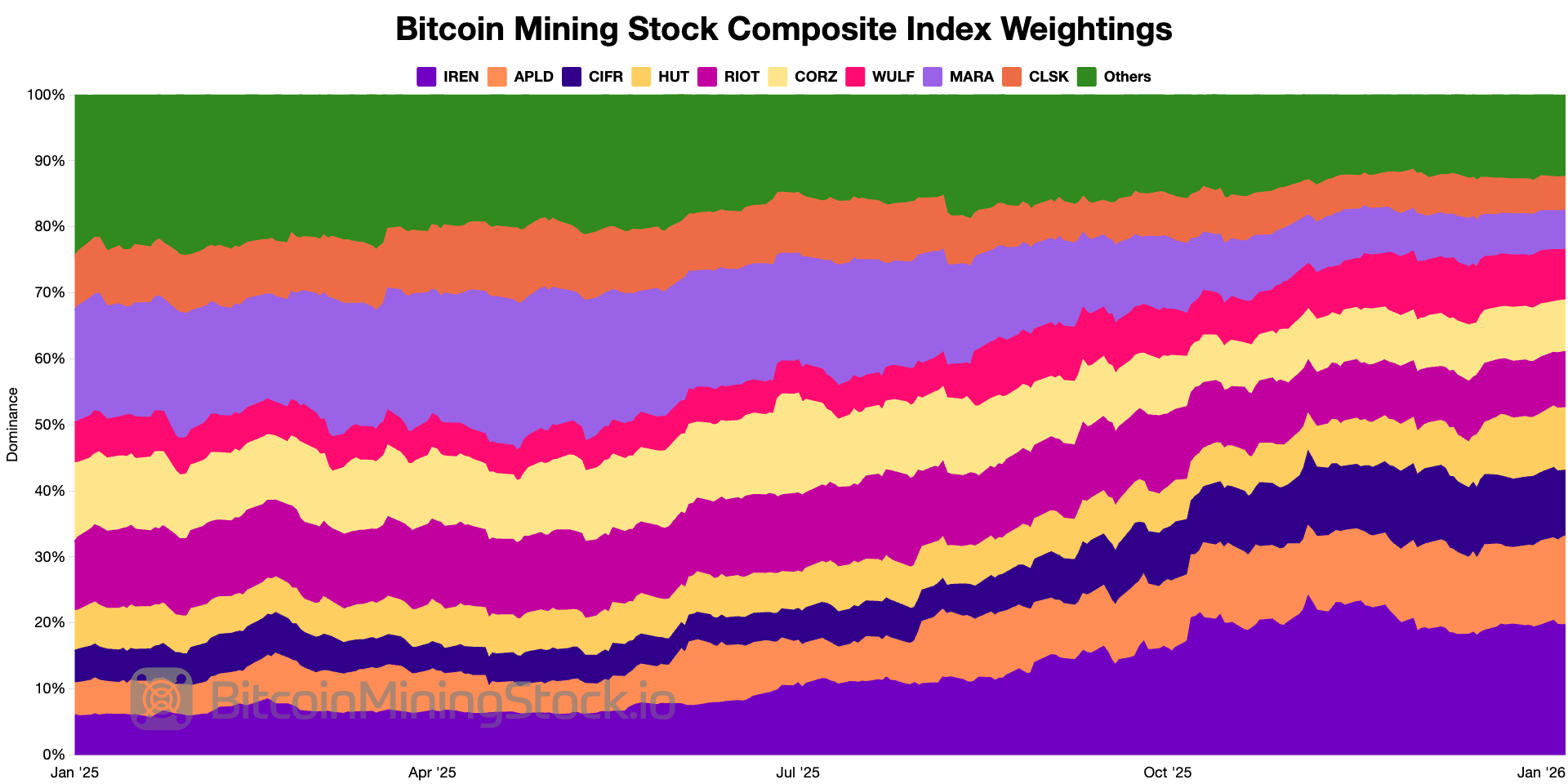
To track the overall performance of the Bitcoin mining sector, we used the Bitcoin Mining Stock Composite Index. The index tracks all publicly traded Bitcoin mining companies listed on major U.S. exchanges, excluding OTC markets. This captures over 80% of the sector’s global market capitalization, providing a robust proxy for investor sentiment across the listed mining space. Each company is then weighted by its market cap, assigning more influence to the larger players at any given time.
From the second half of the year onward, leadership moved away from long-standing names like MARA, Riot, and CleanSpark, toward IREN, Applied Digital, and Cipher Mining, whose rapid valuation expansion made them the dominant drivers of sector performance.
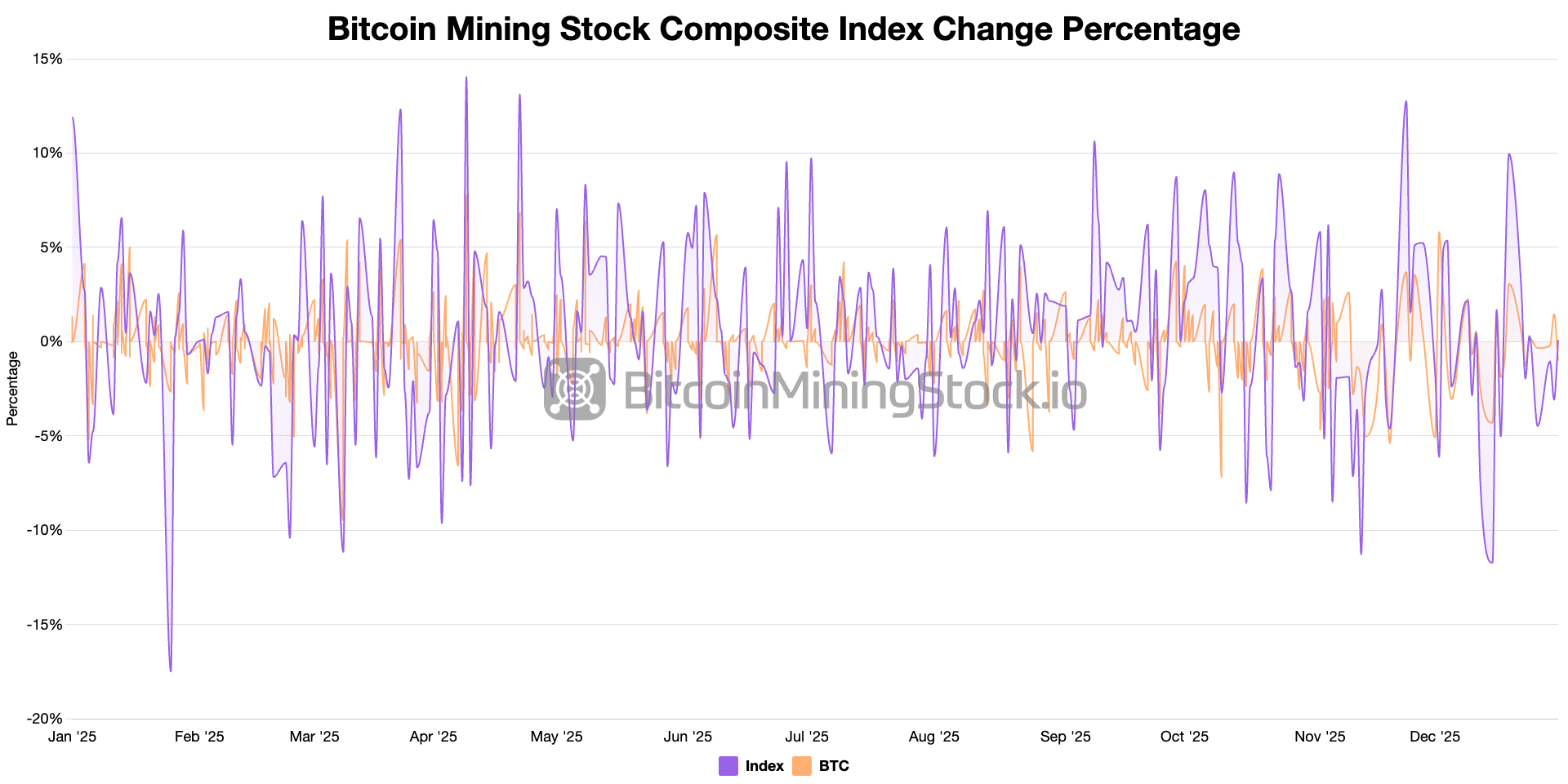
Viewing on a percentage-change basis, mining stocks continued to move in the same general direction as Bitcoin, but with significantly higher volatility. This reinforces their role as a high-beta proxy for Bitcoin, where movements in BTC are often magnified across mining stocks.
That amplification became clear in a simple investment comparison scenario like this: allocate the equivalent of 1 BTC (valued at $96,903 on January 2, 2025) into Bitcoin, and the same dollar amount into the mining stock index. While Bitcoin outperformed in the first half of the year, the tide turned dramatically in the second half. By year-end, Bitcoin posted a return of -9.71%, while the mining stock index delivered an extraordinary gain of +152.34%.
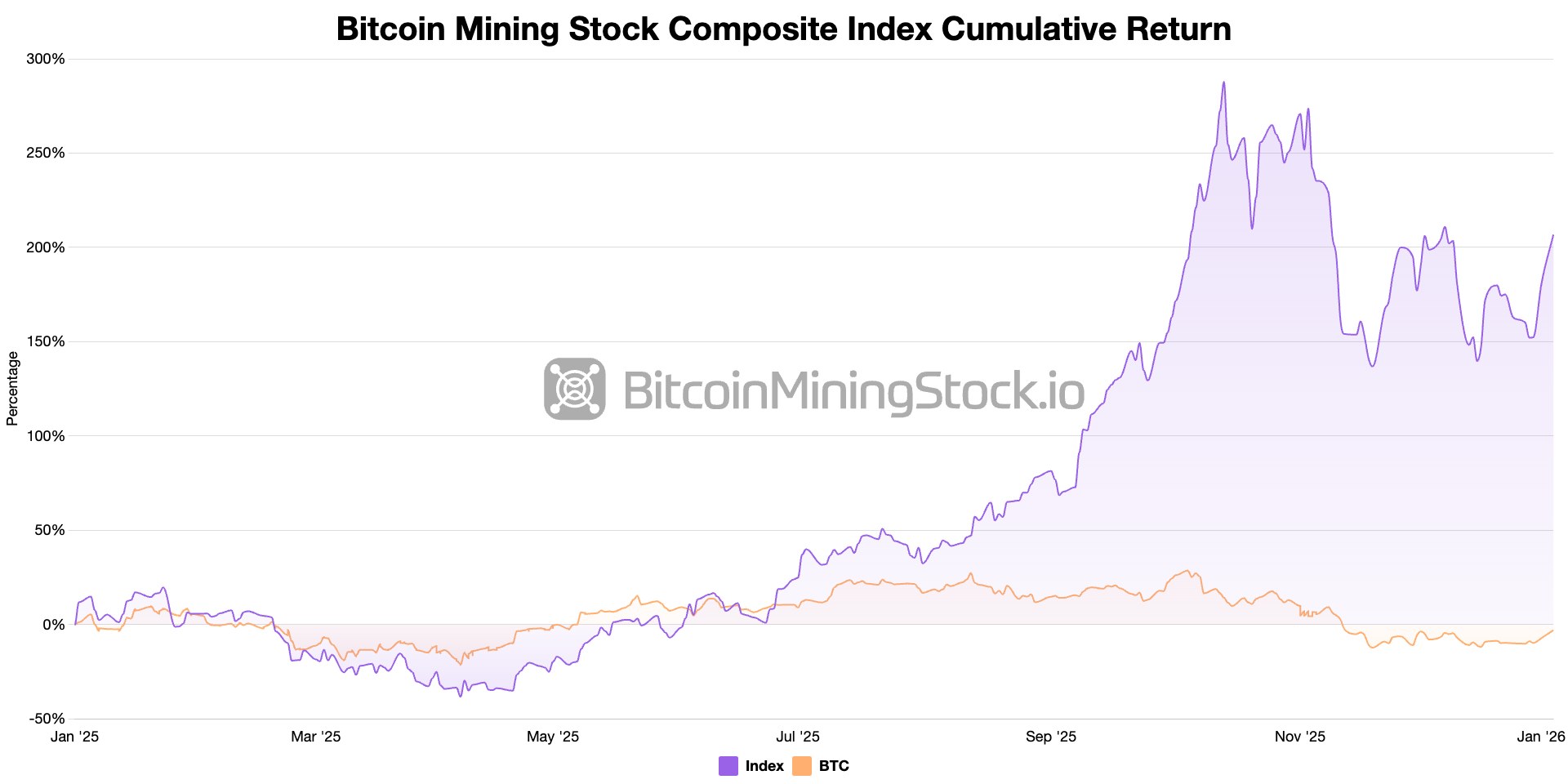
This outperformance did not come without risk. The mining sector’s returns were marked by sharp run-ups and deep pullbacks, underscoring the difficulty of timing entry and exit points. While the index provides a valuable benchmark, it is not directly investable. Still, it offers meaningful insight into how a diversified basket of mining stocks behave across different market regimes. For those seeking exposure, our article on Bitcoin Mining ETFs explores accessible fund options that track this niche segment.
Looking forward, one should be cautious in assuming this relationship will remain unchanged. As miners increasingly pivot toward HPC and AI infrastructure, their fundamentals may begin to diverge from Bitcoin price movements. Even if correlation holds, mining equities have historically underperformed during sustained Bitcoin downturns, making timing and portfolio allocation critical.
So, back to the original question: should one trim mining equities and buy more Bitcoin?
The 2025 data suggests there is no universal answer. Mining stocks dramatically outperformed Bitcoin, but that outperformance was highly cycle-dependent and driven by a narrow group of leaders. The gains came with materially higher volatility and required investors to remain positioned through sharp drawdowns.
For some, that reinforces the case for mining equities as a high-beta expression of Bitcoin exposure. For others, it highlights the appeal of holding Bitcoin directly when price levels are perceived as attractive and volatility tolerance is lower.
Ultimately, the decision comes down to where you believe we are in the market cycle, and how much volatility you are willing to absorb in pursuit of outsized returns.
To explore the methodology behind the Bitcoin Mining Stock Composite Index and discover creative ways to apply it, visit here. You can even customize the components to create your own benchmark tailored to your needs.
Disclaimer: This content is intended for informational purposes only and should not be construed as investment advice. Readers are encouraged to conduct their own research before making any investment decisions. Past performance is not indicative of future results. No recommendation or advice is being provided as to the suitability of any investment for any particular investor.


