




It raises an uncomfortable question: are the executives running these crypto treasury companies any better at timing markets than retail investors? The data suggests most are not - with one notable exception.
This analysis examines the current state of Bitcoin treasury companies, Ethereum treasury companies, and Solana treasury companies - which asset class saw the largest inflows, which saw outflows, and why corporate buying behavior mirrors the same fear-and-greed cycle that drives retail markets.
The Numbers: 6 Months of Treasury Flows
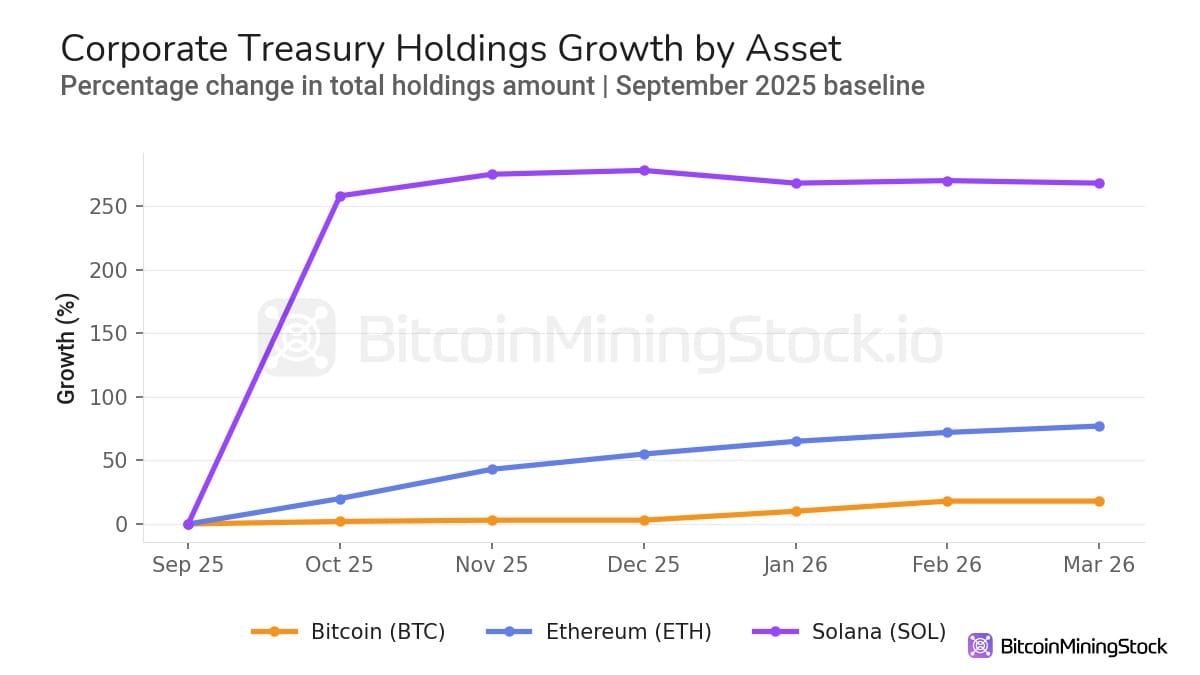
Between September 2025 and March 2026, here is how total corporate holdings shifted across the three major crypto treasury categories:
- Bitcoin treasury companies grew their collective holdings by 17.1%, from approximately 967,000 BTC to over 1,132,800 BTC.
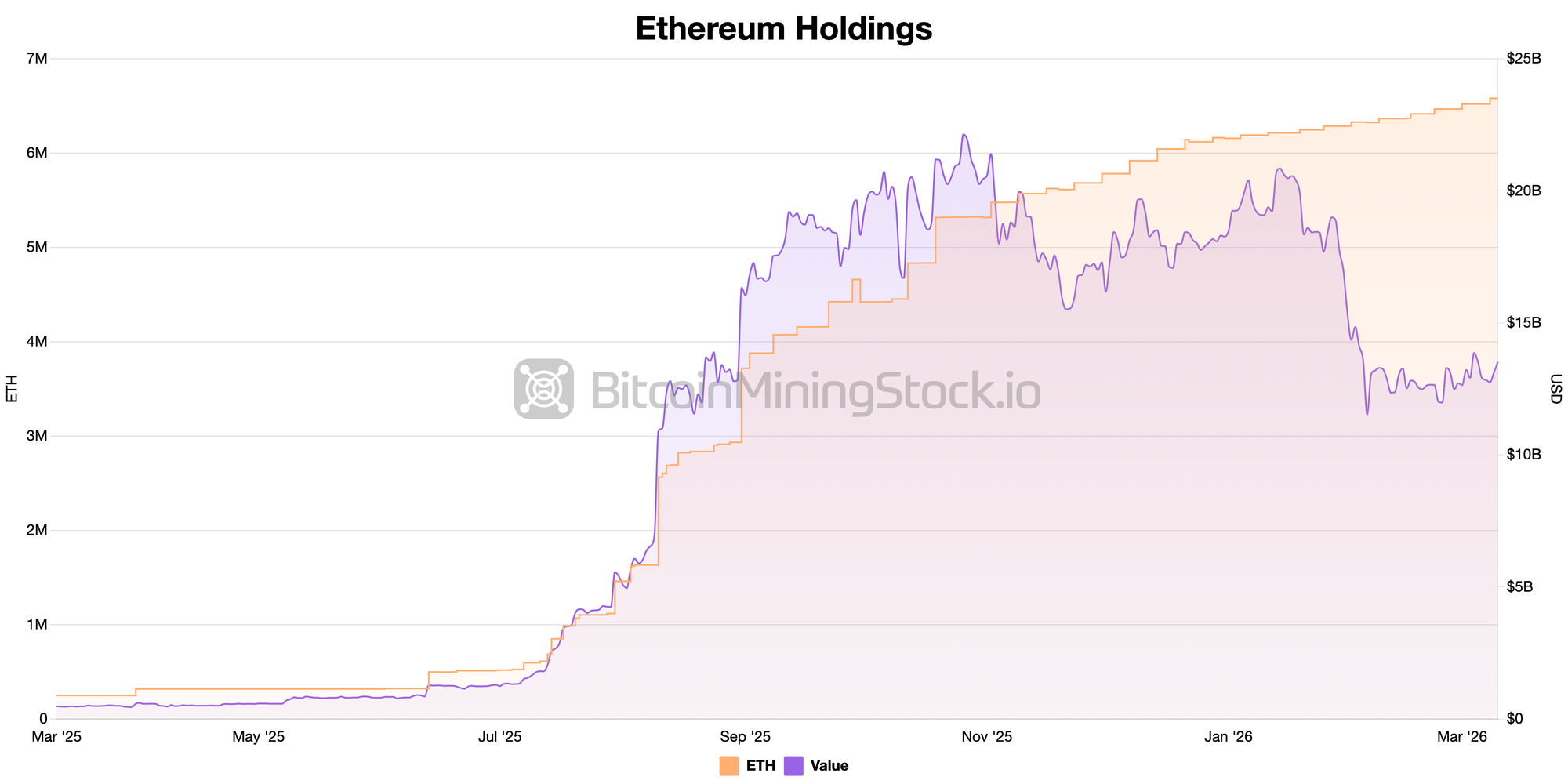
- Ethereum treasury companies had 77% growth in token holdings, from 3.7 million to 6.58 million ETH.
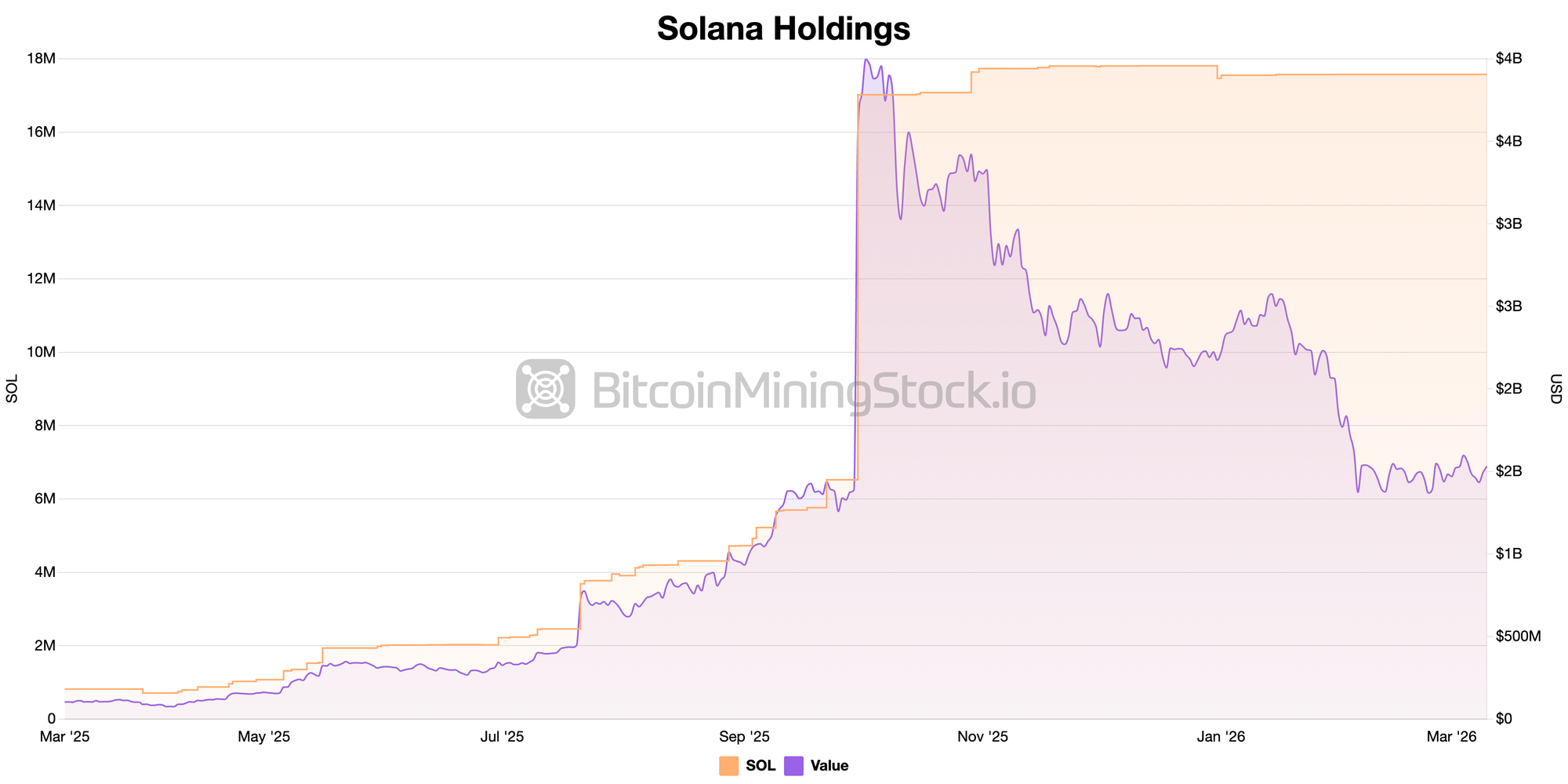
- Solana treasury companies saw the largest percentage increase at 272% with virtually all growth coming from a single company’s acquisition in September 2025. Holdings have been flat at ~17.5 million SOL since.
But here's the critical context: these figures include the aggressive buying that happened while prices were still elevated. The picture changes dramatically when you split the timeline.
The Buying Happened at the Top
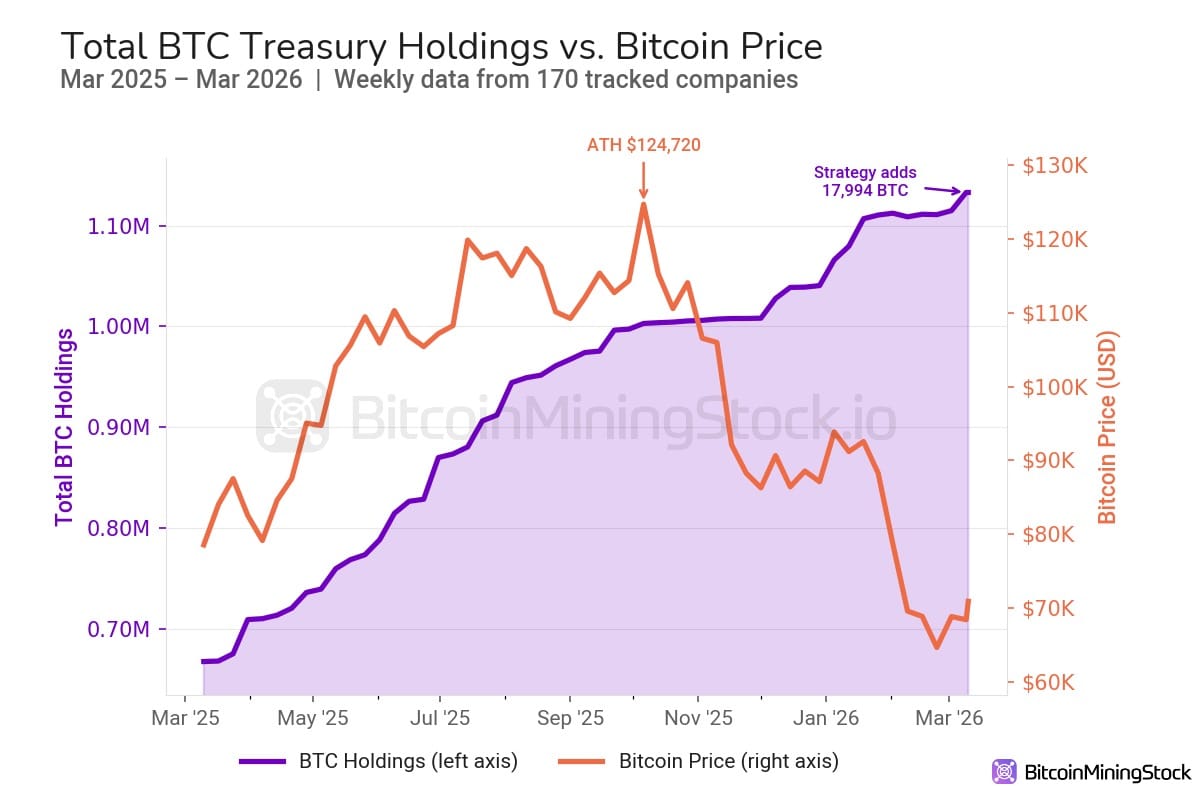
Bitcoin hit its all-time high of $124,720 on October 6, 2025. In the months surrounding that peak, corporate treasuries were buying aggressively:
- Q4 2025 (Oct-Dec): BTC treasuries added approximately 62,085 BTC while Bitcoin traded between $87,000 and $125,000
- Q1 2026 (Jan-Mar): BTC treasuries added approximately 68,526 BTC with Bitcoin falling from $87,000 to the current level of $71,400
At the aggregate level, Q1 2026 buying actually exceeded Q4 - but this is almost entirely driven by one company: Strategy Inc. Strip out Strategy, and the rest of the ecosystem's buying pace has collapsed. Most companies that were loudly accumulating at $100,000+ have gone quiet, or started selling, now that Bitcoin trades 43% below its peak.
The pattern is even more stark when you look at individual companies.
Strategy (MSTR): The Lone Conviction Buyer
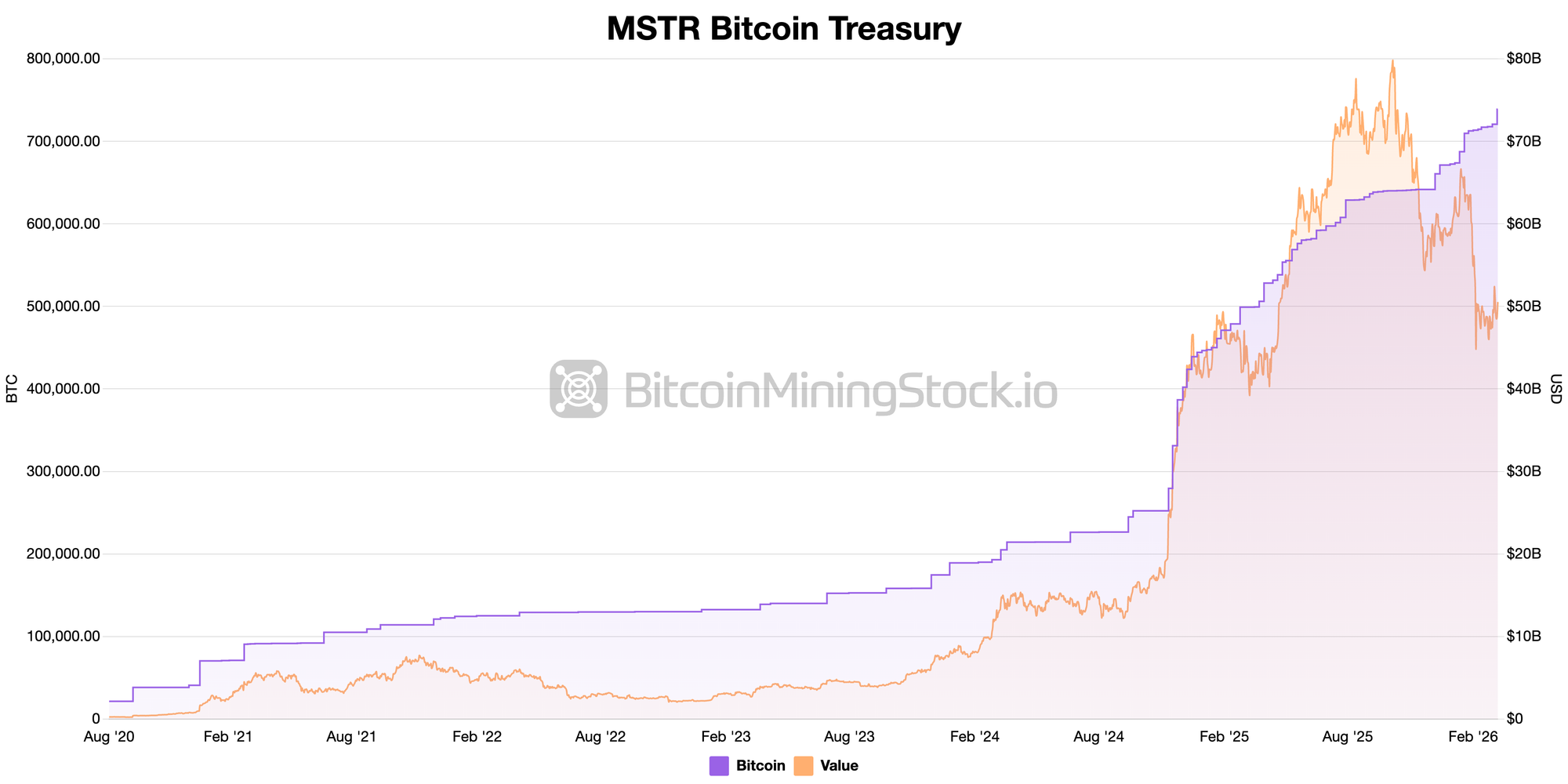
Strategy Inc. (formerly MicroStrategy) remains the dominant force in corporate Bitcoin holdings with 738,731 BTC as of March 8, 2026, representing 65.2% of all publicly held corporate Bitcoin. The company has added 102,226 BTC since September 2025, and crucially, its buying has accelerated rather than slowed:
- Q4 2025 (Oct-Dec): Added approximately 37,278 BTC at prices between $87,000 and $125,000
- Q1 2026 (Jan-Mar): Added approximately 64,948 BTC with Bitcoin falling to $70,000
Strategy is the rare company that passes the conviction test. While other treasury companies retreated, Strategy increased its Q1 buying pace by 74% compared to Q4 - including a single-week purchase of 17,994 BTC announced on March 8. The company's weekly filings have ranged from modest additions of 591 BTC to multi-billion-dollar acquisitions, but the overall trajectory is unmistakable: they are buying more, not less, as prices fall.
Ethereum Treasuries: Growth Driven by a Few Large Players
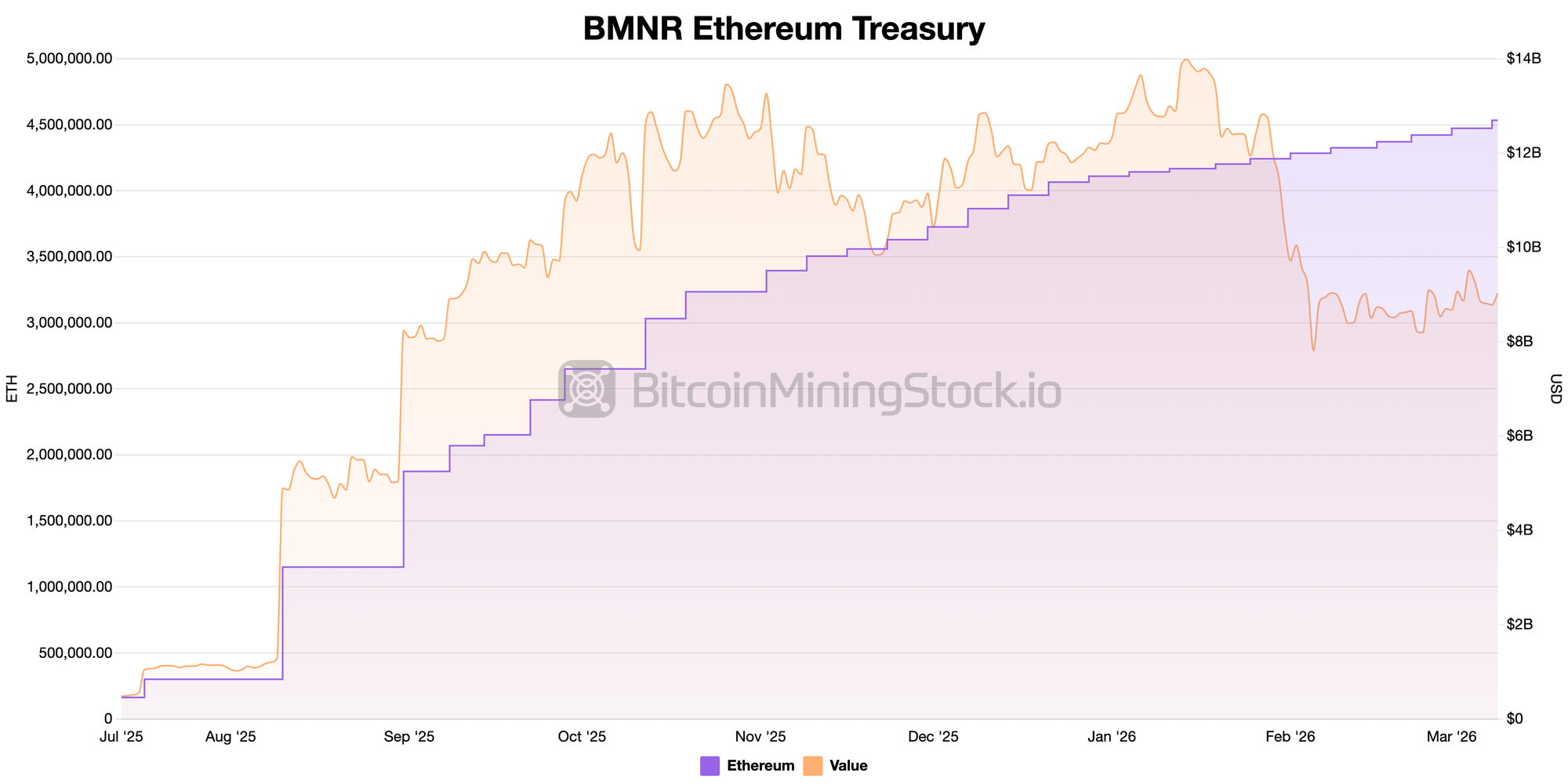
The 77% growth in ETH treasury holdings looks impressive on the surface, but it is heavily concentrated in a small number of companies. The Ethereum treasury space is dominated by:
- Bitmine Immersion (BMNR): Grew from 2,650,900 ETH to 4,534,563 ETH (+71.1%), now the largest ETH treasury company by a wide margin
- SharpLink Gaming (SBET): Increased from 580,841 ETH to 868,699 ETH (+49.6%)
- The Ether Machine (ETHM): Accumulated 496,712 ETH by October 2025, making it the third-largest ETH treasury company, but has not reported any new purchases in over five months
Meanwhile, some ETH treasury companies moved in the opposite direction. Ethzilla Corp. (ETHZ) reduced holdings from 102,273 ETH to 65,850 ETH - a 35.6% decrease. SOLAI Limited (SLAI) slashed its ETH position by 86%.
The total number of publicly traded companies (tracked by our platform) with Ethereum treasury positions currently sits at 36, compared to over 160 Bitcoin treasury companies. The ETH treasury trend remains newer and more concentrated, making aggregate numbers susceptible to large swings from individual players.
Solana Treasuries: The Momentum Has Stalled
Solana treasury companies tell perhaps the most revealing story. After a frenzy of accumulation through mid-2025, led by Forward Industries (FWDI) with nearly 7 million SOL, Solana Company (HSDT) with 2.3 million SOL, and DeFi Development Corp. (DFDV) growing from 2,858 SOL in April 2025 to over 2.2 million SOL, total SOL holdings have essentially plateaued.
Total SOL holdings peaked at 17.8 million in December 2025 and have since declined slightly to 17.6 million. The 22 companies holding SOL on their balance sheets represent the smallest treasury category, and several have been net sellers:
- DigitalX (DCC.AX): Reduced SOL holdings by 76% from their May 2025 peak of 125,456 to 20,521 SOL by year-end, though most of that selling occurred before September 2025
- SOL Global Investments (SOL.CN): Cut holdings by 26% (from 40,350 to 29,858 SOL) in the first nine months of 2025
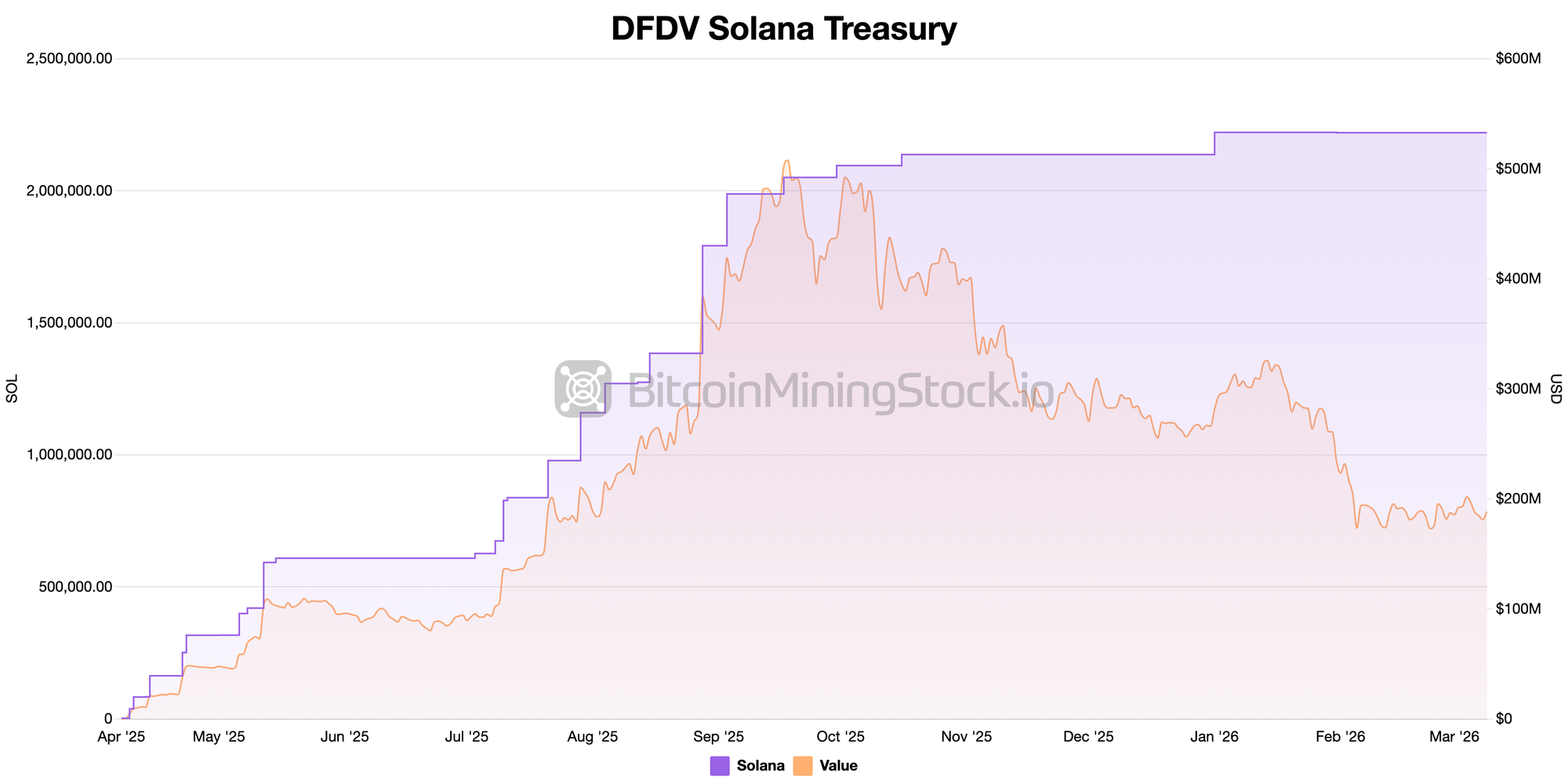
DeFi Development Corp. (DFDV), the third-largest Solana treasury company behind Forward Industries (FWDI) and Solana Company (HSDT), has also slowed. After adding hundreds of thousands of SOL per month through late 2025, its January 2026 update showed a modest net decrease of 1,329 SOL to 2,220,000 SOL. With SOL trading at $88, well below its 2025 highs above $200, the company that pioneered the Solana treasury strategy has effectively paused.
Why Aren't They Buying the Dip?
The standard argument from crypto treasury advocates is simple: these assets are undervalued long-term holdings, and the company is converting balance sheet cash into a superior store of value. That thesis doesn't change, and arguably strengthens, when prices fall.
Yet the data shows the opposite behavior from most companies. Several factors explain the disconnect:
Capital constraints tighten in downturns. Many of these companies fund purchases through equity raises (at-the-market offerings, convertible notes). When stock prices fall alongside crypto, issuing new shares becomes more dilutive and less attractive - a dynamic visible in enterprise value data across the sector. Strategy's stock price, for example, has declined significantly from its 2025 highs, making each dollar raised more expensive in terms of shareholder dilution, yet the company continues buying regardless.
Board and shareholder pressure increases. It's easy to approve a Bitcoin purchase strategy when BTC is hitting new all-time highs and the stock is rallying. It is considerably harder to justify continued buying when both the asset and the stock are down 30-40%. Directors become cautious. Shareholders ask harder questions.
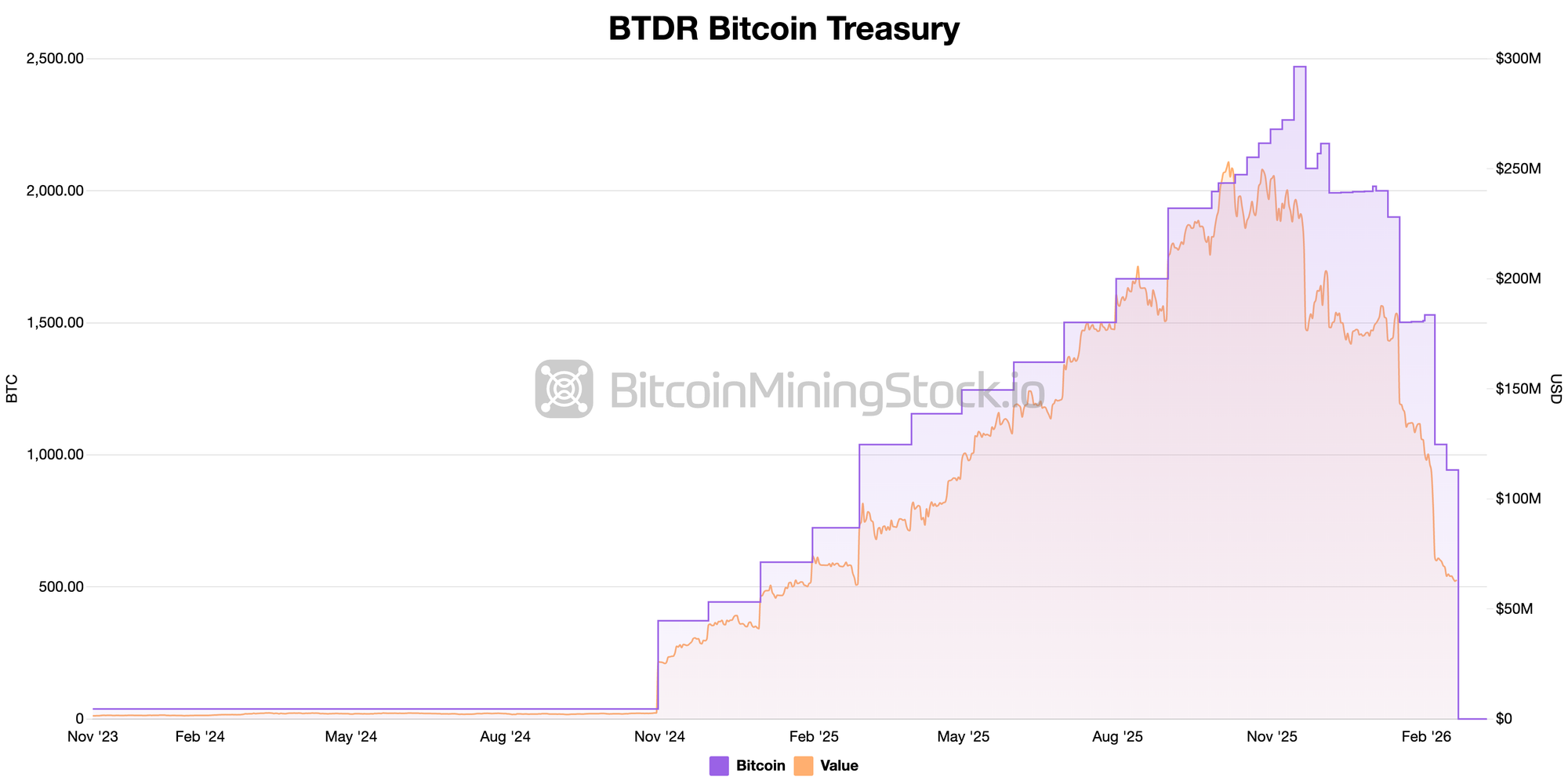
Some companies are actively selling, or reallocating capital entirely. Bitdeer Technologies (BTDR) sold 100% of its Bitcoin holdings, going from 2,029 BTC in September 2025 to zero by February 20, 2026. The company steadily unwound its position over several months, accelerating sales in January and February as prices fell. Genius Group (GNS) cut holdings by 58%, dropping from 200 BTC to just 84 BTC. These are companies exiting treasury positions outright.
Others are making more strategic moves. Cango Inc. (CANG) reduced its Bitcoin holdings by 59.5% in February 2026, selling approximately 4,451 BTC, but the context matters. Cango used the proceeds to repay a BTC-collateralized loan and fund its expansion into AI compute infrastructure, deploying modular GPU nodes across 40+ sites and hiring a new AI CTO. The company subsequently resumed buying, adding 290 BTC before month-end to finish February at 3,313 BTC, and secured $65 million in additional equity financing. This looks less like panic selling and more like a deliberate capital reallocation to position for the AI data center opportunity - a move that could ultimately complement its remaining BTC treasury.
Fear is the dominant emotion. At its core, this is the same behavioral cycle that affects all market participants. Executives are human. They feel urgency to buy when prices are rising and narratives are bullish. When sentiment turns, the same urgency shifts toward caution, preservation, and waiting for "clarity." The corporate treasury wrapper doesn't immunize decision-makers from these impulses.
What This Means for Investors
The crypto treasury trend is not going away. The number of publicly traded companies holding digital assets on their balance sheets continues to grow, now spanning over 200 companies tracked on our crypto treasury tracker.
But investors should look past the corporate press releases and examine the actual behavior. Key takeaways:
- Accumulation rates matter more than total holdings. A company announcing "record BTC holdings" while its monthly purchases have dropped 70% is telling two different stories.
- Watch for changing treasury strategies. Not all sales signal panic — some reflect deliberate capital reallocation. The reason behind a sale matters as much as the sale itself. Monitor holding changes monthly, not just headline totals.
- ETH and SOL treasuries are highly concentrated. A single company's decision can move aggregate numbers significantly. Treat these categories with appropriate caution.
- The "conviction" test is in the downturn. Any company can buy Bitcoin at $120,000 when the market is euphoric. The companies buying at $70,000 with the same or greater intensity are the ones with genuine long-term conviction. Very few pass this test.
What to Watch Next
The crypto treasury space is entering its first real stress test. The 2024-2025 bull market made corporate Bitcoin buying look visionary. The current correction, with Bitcoin down 43% from its $124,720 peak to $71,400, is separating companies with genuine long-term conviction from those that were riding momentum.
Check Q1 2026 earnings calls this month and last. How executives discuss their treasury strategies during a downturn will reveal more than any bull-market press release. Strategy's decision to accelerate buying, adding 65,000 BTC in Q1 alone, sets a benchmark that few will match. The companies that follow suit, not just maintain existing positions, will have the strongest case for long-term value creation.
Disclaimer: This content is intended for informational purposes only and should not be construed as investment advice. Readers are encouraged to conduct their own research before making any investment decisions. Past performance is not indicative of future results. No recommendation or advice is being provided as to the suitability of any investment for any particular investor.
FAQ
Which crypto treasury type had the most inflows in the last 6 months?
Ethereum treasury companies saw the largest percentage growth, with total ETH holdings increasing 77% from 3.7 million to 6.58 million ETH. However, this growth was heavily driven by a few large players, particularly Bitmine Immersion Technologies. In absolute dollar terms, Bitcoin treasury companies added far more value.
How much Bitcoin do public companies hold in 2026?
As of March 10, 2026, publicly traded Bitcoin treasury companies hold a combined 1,132,867 BTC, worth approximately $80.9 billion at current prices - track the full list on our Bitcoin treasury tracker. Strategy Inc. (MSTR) alone accounts for 738,731 BTC, roughly 65.2% of the total.
Why are most companies not buying crypto at lower prices?
Several factors contribute: tighter capital markets make equity raises more dilutive, board-level risk appetite decreases during downturns, and executive decision-making is subject to the same fear-and-greed dynamics as retail investors. Some companies have actively sold - Bitdeer liquidated its entire BTC position and Genius Group sold 58%. Others like Cango Inc. have reallocated treasury assets to fund strategic pivots such as AI infrastructure expansion. The notable exception is Strategy Inc., which has accelerated buying in Q1 2026.
How many public companies hold Solana on their balance sheet?
There are currently 22 publicly traded companies with Solana treasury positions tracked on our Solana treasury tracker, holding a combined 17.6 million SOL worth approximately $1.5 billion.


